
Article · SwissTechNova
How to Protect Your Capital Investment with Smart Risk Management
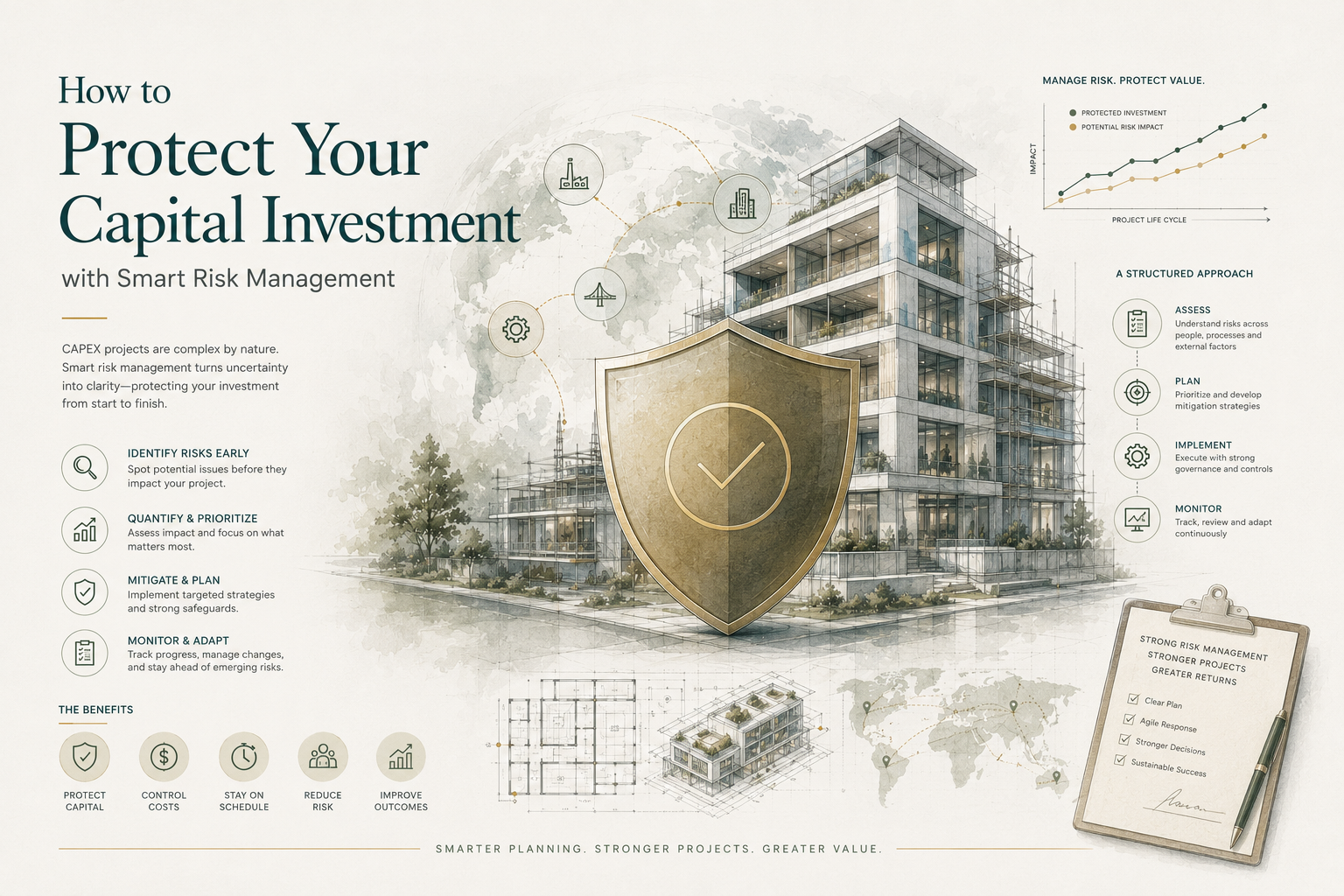
CAPEX (Capital Expenditure) projects (for example an appartment building, a pharmaceutical manufacturing line, industrial plant modification, a large-scale construction) carry significant financial risk. Applying structured risk management frameworks and active portfolio oversight protects capital expenditure from cost overruns, schedule delays, and qualification failures, giving investors and project owners measurable confidence at every stage.
Why CAPEX Risk Management Matters More Than Ever in Switzerland
Switzerland's regulatory environment, high labour costs, and complex stakeholder landscape make capital expenditure projects inherently demanding. A pharma facility in Basel, a data centre near Zurich, or an industrial upgrade in the Mittelland all share one challenge: once capital is committed, the margin for error is thin. Unmanaged risks (scope creep, procurement delays, regulatory non-conformance) can erode returns rapidly and permanently.
Effective risk management is not a compliance checkbox. It is the mechanism by which smart organisations protect the value of their capital decisions before, during, and after construction or commissioning. According to the Project Management Institute, organisations with mature risk processes waste significantly less of their project investment than those without structured frameworks a difference that is acutely felt on high-value Swiss capital projects.
The Core Risk Framework SwissTechNova Applies to CAPEX Projects
SwissTechNova's approach to capital investment risk is built around four interconnected disciplines that run from feasibility through to project close-out.
1. Early-Stage Risk Identification and Feasibility Analysis
Risk cannot be managed if it is not first understood. Before any capital is approved, SwissTechNova conducts structured feasibility and site analysis studies that surface technical, regulatory, and commercial risks. This early visibility allows project owners to make informed go/no-go decisions and structure their budgets with realistic contingency provisions, rather than discovering problems once groundwork has begun.
2. Risk Quantification and Prioritisation
Not all risks are equal. SwissTechNova uses qualitative and quantitative risk assessment methods, including probability-impact matrices and Monte Carlo scenario modelling where appropriate, to measure and rank risks by their potential effect on schedule and cost. This prioritisation ensures that project resources and management attention are directed where they matter most.
3. Mitigation Planning and Contractual Safeguards
Identified and ranked risks are then addressed through targeted mitigation measures: alternative supplier strategies, phased procurement, design tolerances, and, where necessary, contractual risk allocation with contractors and vendors. In Switzerland's competitive construction and engineering market, clear contractual frameworks protect the owner from liability transfers and cost escalation clauses that can be quietly embedded in standard terms.
4. Continuous Monitoring Through Full-Cycle Project Management
Risk management is not a one-time exercise. SwissTechNova's engineering project management service provides full-cycle oversight, with regular risk register reviews, earned value tracking, and schedule variance analysis embedded into project governance. This means emerging risks are caught early, when they are still correctable, rather than at the point of crisis.
Portfolio Oversight: Managing Multiple CAPEX Investments at Once
For organisations running parallel capital programmes, individual project risk management is necessary but not sufficient. Portfolio-level oversight provides the visibility that executive teams need to make informed decisions about resource allocation, prioritisation, and risk tolerance across their entire capital portfolio.
SwissTechNova's portfolio risk and management solutions offer consolidated reporting across multiple projects, enabling leadership to identify systemic risks (such as a single-supplier dependency affecting several sites), rebalance resources dynamically, and make capital reallocation decisions based on real performance data rather than optimistic project-level reports.
This portfolio lens is particularly valuable when a business is running a major new build alongside an ongoing renovation programme, two investment streams with different risk profiles, timelines, and regulatory touchpoints that must be managed without cannibalising each other's resources.
Sector-Specific Considerations for Pharma and Industrial CAPEX in Switzerland
Pharmaceutical and industrial CAPEX projects in Switzerland carry additional complexity in the form of GMP compliance, equipment qualification (IQ/OQ/PQ), and regulatory authority interactions with Swissmedic or international bodies. A cost overrun at the construction phase can cascade into delayed commissioning, extended qualification timelines, and ultimately a delayed product launch, compounding the financial impact far beyond the original scope.
SwissTechNova's engineering and industry background means that qualification and validation risks are built into the risk register from the outset, not treated as an afterthought once civil works are complete. This integrated approach combining architecture, engineering, and commissioning expertise under one practice reduces the interface risk that often causes the most expensive problems on complex CAPEX projects.
For organisations that need senior-level direction at short notice, interim project management offers experienced leadership continuity without the timeline of a permanent hire.
What Good CAPEX Governance Looks Like in Practice
Strong governance for capital projects typically includes the following elements, all of which SwissTechNova can structure or support:
- A defined investment decision gate process — clear approval milestones before each major phase of spend is released.
- An active, living risk register — reviewed at every project status meeting, not archived after the kick-off workshop.
- Transparent cost reporting — actual versus budget, forecast at completion, and contingency burn-rate presented to decision-makers in real time.
- Independent project review — periodic third-party assessment of schedule and cost health, particularly useful for projects running beyond 12 months.
- Clear escalation paths — defined thresholds at which project risks must be escalated to executive or board level for decision.
Key Takeaways
- Start risk management before capital is approved — feasibility and site analysis are the most cost-effective investment in de-risking any CAPEX project.
- Quantify risks, not just list them — probability-impact analysis and scenario modelling turn a risk register into a genuine decision-support tool.
- Portfolio oversight protects against systemic blind spots — individual project reporting rarely surfaces cross-programme resource and supply chain risks.
- Pharma and industrial CAPEX need qualification risk built in from day one — late-stage GMP issues are among the most expensive problems on Swiss infrastructure projects.
- Full-cycle project management closes the loop — continuous monitoring is what converts a risk framework from a document into a living safeguard.
If you are planning or already running a significant capital investment programme in Switzerland, speaking with SwissTechNova's project and portfolio team is a practical first step toward structuring the oversight your investment deserves. With an average of 19 years' professional experience across architecture and engineering, the practice brings the depth that complex CAPEX projects demand.