
Article · SwissTechNova
How Food Tech and Food Innovation Companies Can De-Risk Their Capital Projects
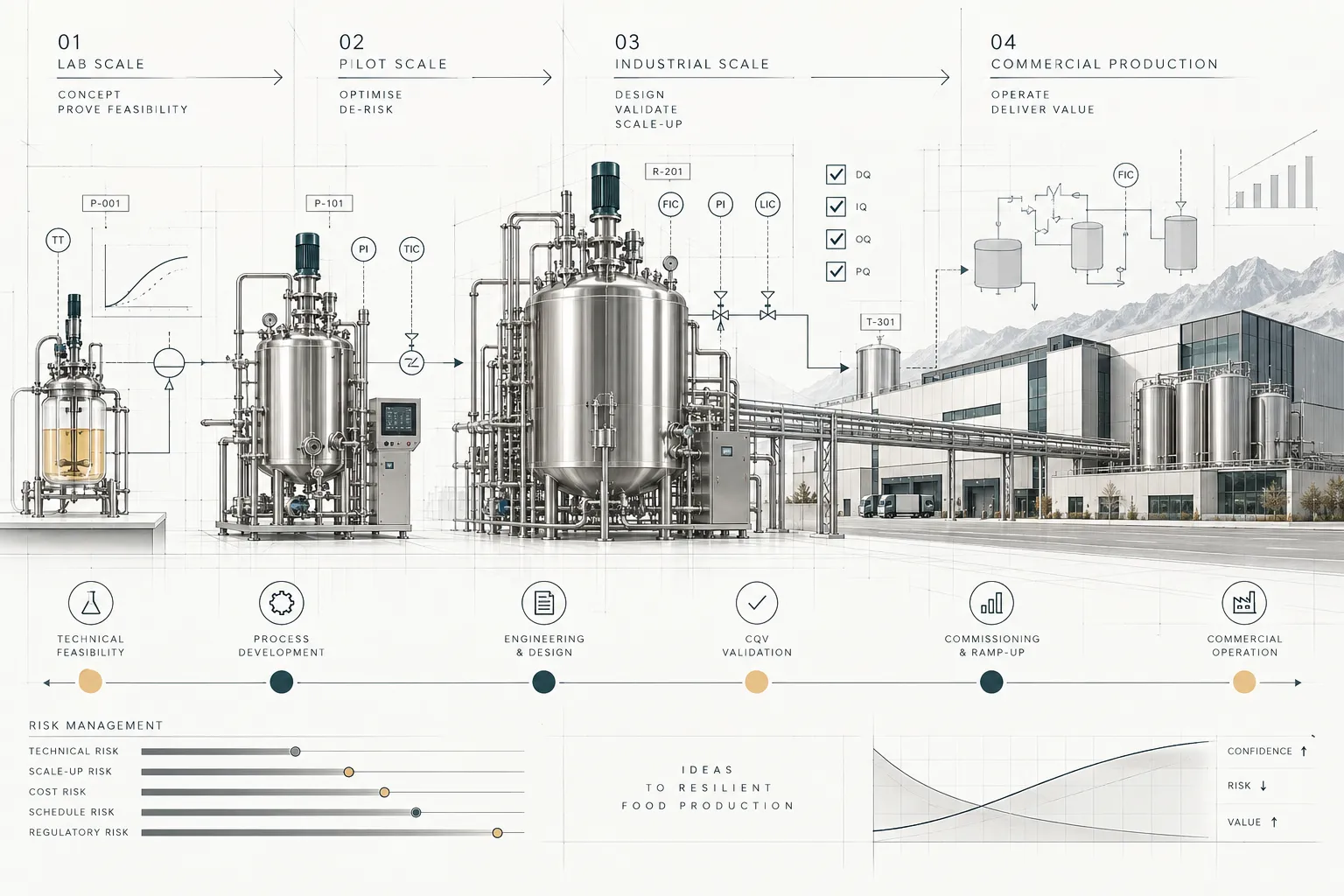
Food tech and food innovation companies face a rare combination of challenges when committing capital to manufacturing scale-up: novel process technology that has not been validated at production scale, regulatory requirements that evolve as the science does, and investor timelines that leave little room for the delays that complex facility projects routinely generate. Understanding where the risks concentrate — and how to manage them before they compound — is the starting point for any capital project that intends to deliver on time and within budget.
Why Food Tech Capital Projects Are Structurally Different
Industrial food manufacturing shares many features with other regulated sectors — qualified utilities, validated equipment, formal commissioning protocols — but food tech and alternative protein companies face additional layers of uncertainty that standard project management frameworks were not designed to handle.
Process technology risk is the most significant differentiator. A pilot plant operating at 100-litre scale does not guarantee stable performance at 10,000 litres. Fermentation dynamics, thermal profiles, yield consistency, and contamination sensitivity can all shift in ways that require design changes after the facility is already under construction. Building a facility around process assumptions that subsequently prove incorrect is among the most expensive mistakes in food innovation capital investment.
Regulatory uncertainty adds a further layer. Novel food categories — precision-fermented proteins, cell-cultured products, biofermentation-derived ingredients — face regulatory review timelines that are not fully predictable in most jurisdictions. A facility designed around a regulatory outcome that takes longer than expected, or that requires modified production parameters, can find itself delayed at a point when sunk costs are already substantial.
Key Risk Categories in a Food Tech Facility Project
A systematic approach to risk in food tech capital projects organises the problem into four primary categories.
Process and technology risk covers whether the production process can be reliably scaled, whether the technology has been de-risked at an appropriate scale before facility investment begins, and whether the facility design can accommodate process modifications without major rework. Resolving this requires detailed process engineering, scale-up studies, and conservatively specified equipment with room for parameter adjustment.
Regulatory and compliance risk covers whether the facility can obtain the necessary approvals — construction permits, food safety certifications, novel food authorisations — within the project timeline. Early engagement with relevant authorities and regulatory consultants, before final design decisions are made, is the most effective mitigation.
Supply chain and procurement risk remains underestimated in food innovation projects. Specialist equipment for fermentation, separation, and sterile processing is frequently long-lead, and key suppliers may serve multiple competing buyers simultaneously. Procurement strategy — including whether to standardise around available equipment or to specify bespoke — has significant schedule implications.
Execution and project management risk is often the category that converts the other three into actual delays. A project with manageable technology risk, a clear regulatory path, and workable supply chains can still fail to deliver on time if the project management framework is not suited to the pace of decisions that food tech capital projects require.
Commissioning, Qualification, and Validation for Food Manufacturing
Any facility producing food or food ingredients for human consumption requires a structured commissioning, qualification, and validation (CQV) programme — even where formal GMP requirements do not apply. The principles are the same: demonstrate that the facility, its utilities, and its equipment are installed correctly, operate as intended, and consistently produce output that meets specification.
For food tech companies, CQV planning should begin at the design stage, not after construction is complete. Systems that are difficult to clean, utilities that are hard to validate, or equipment that cannot be adequately instrumented create commissioning problems that are expensive to resolve once built. Early-stage commissioning input can prevent these issues for a fraction of the cost of remediation.
EU Novel Food Regulation (2015/2283) and Food Safety Modernization Act (FSMA) requirements in the US increasingly align on the expectation that manufacturing processes be validated and that facilities operate under documented procedures with defined performance criteria. Investment in CQV infrastructure is not optional for any food tech company that intends to operate at commercial scale or supply international markets.
Project Management That Matches the Pace of Food Innovation
Food tech capital projects require project management that is comfortable with moving targets. Technology parameters that shift during construction, regulatory guidance that evolves mid-project, and investor milestones that do not align with procurement lead times are routine features of the landscape. A project management framework that requires complete specification before any action can be taken will fail in this environment.
Effective project leadership for food tech capital investment provides three things simultaneously: a structured framework that controls cost and schedule, enough flexibility to incorporate necessary changes without triggering full project restarts, and clear risk visibility so that stakeholders — investors, management, regulatory counterparts — understand the current status with accuracy.
When a project requires leadership reinforcement at pace — whether due to a personnel gap, a need to accelerate, or the recognition that existing internal capacity is insufficient for the project’s complexity — interim project management provides deployable expertise without the timelines of a permanent hire.
The SwissTechNova Approach
SwissTechNova brings engineering and project management expertise to capital projects in food tech, life science, and other regulated or technically intensive sectors. Our project work spans feasibility and process review through commissioning, qualification, and validation — with the capability to manage the full project cycle or to provide targeted expertise at the phases where it matters most.
Based in Zollikon, Zurich, and operating across Switzerland and the broader European market, our team works in multiple languages and is familiar with both Swiss and EU regulatory environments. We approach food tech capital projects with the same precision and discipline we apply to pharmaceutical and industrial engineering projects, recognising that the consequences of project failures in capital-intensive food innovation are both financial and reputational. Contact us to discuss how we can support your next project.
Key Takeaways
- Process and technology risk in food tech capital projects should be resolved at pilot scale before facility investment is committed. Late-stage process changes are among the most expensive outcomes in food manufacturing scale-up.
- CQV planning begins at design stage, not after construction. Systems that are hard to validate create commissioning problems that cost multiples of prevention.
- Regulatory engagement should happen before design lock, not after. Early dialogue with food safety authorities surfaces requirements that affect facility specification.
- Procurement strategy has direct schedule consequences. Long-lead specialist equipment requires early decisions that may need to be made before process parameters are final.
- Project management for food tech capital projects must balance structured control with the flexibility to incorporate necessary changes without project restarts.