
Article · SwissTechNova
How to Keep Pace with AI Without Compromising Your Sustainability Values
At SwissTechNova, we pursue two ambitions that should reinforce each other.
We want to promote responsible and sustainable development. And we want to be a sparring partner for innovation — helping organisations turn emerging technologies into useful solutions for businesses and society.
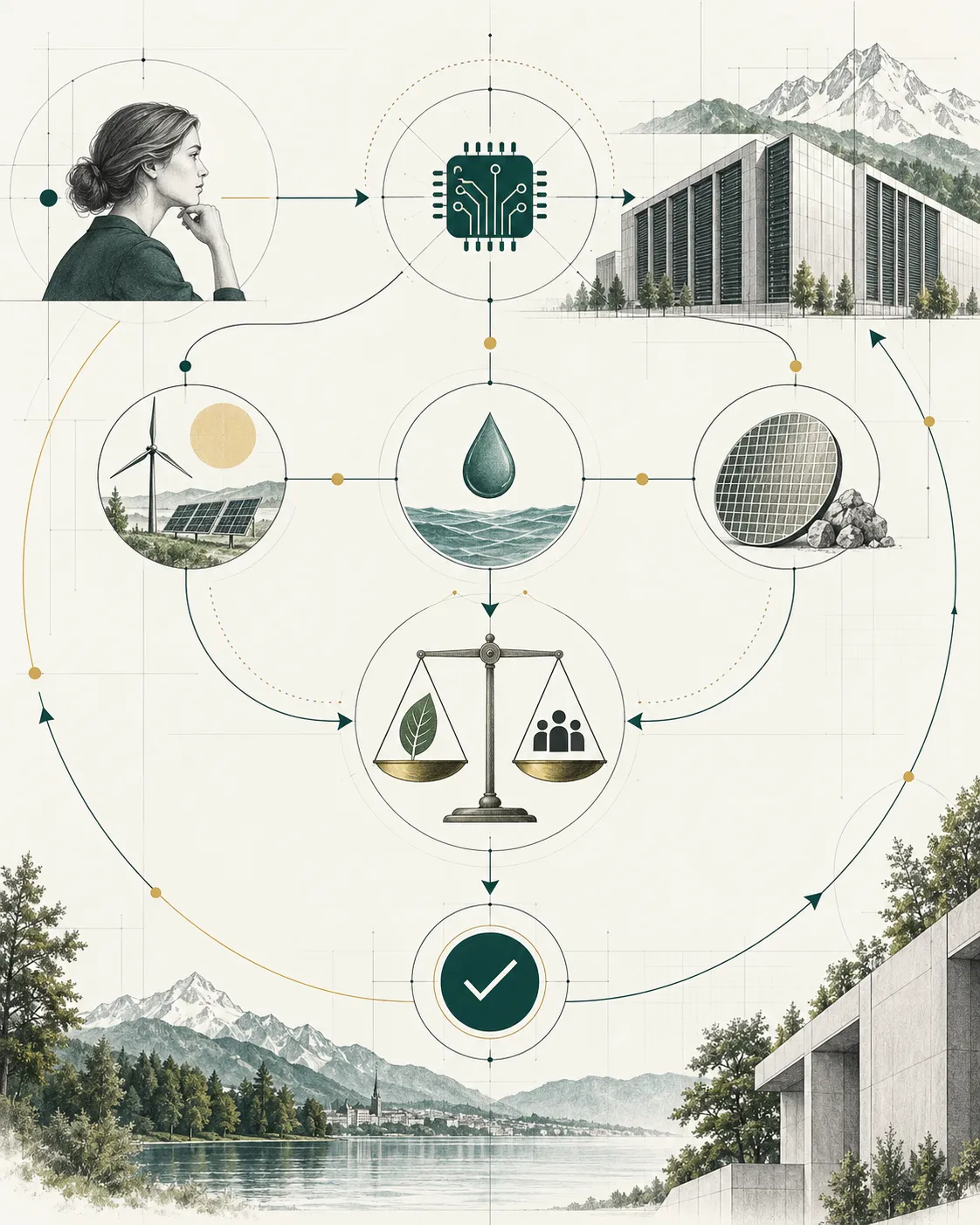
Artificial intelligence has forced us to examine where these objectives can come into tension. Not theoretically. Through our own work.
Over recent months, we have developed functional applications using no-code platforms combined with LLM-based guidance.
One is a project portfolio management tool structured around the SIA project framework, designed to improve visibility across projects, phases, priorities and resources.
The other is Business Scout, a business-intelligence demonstration tool that explores how fragmented business information can be structured and made easier to interpret.
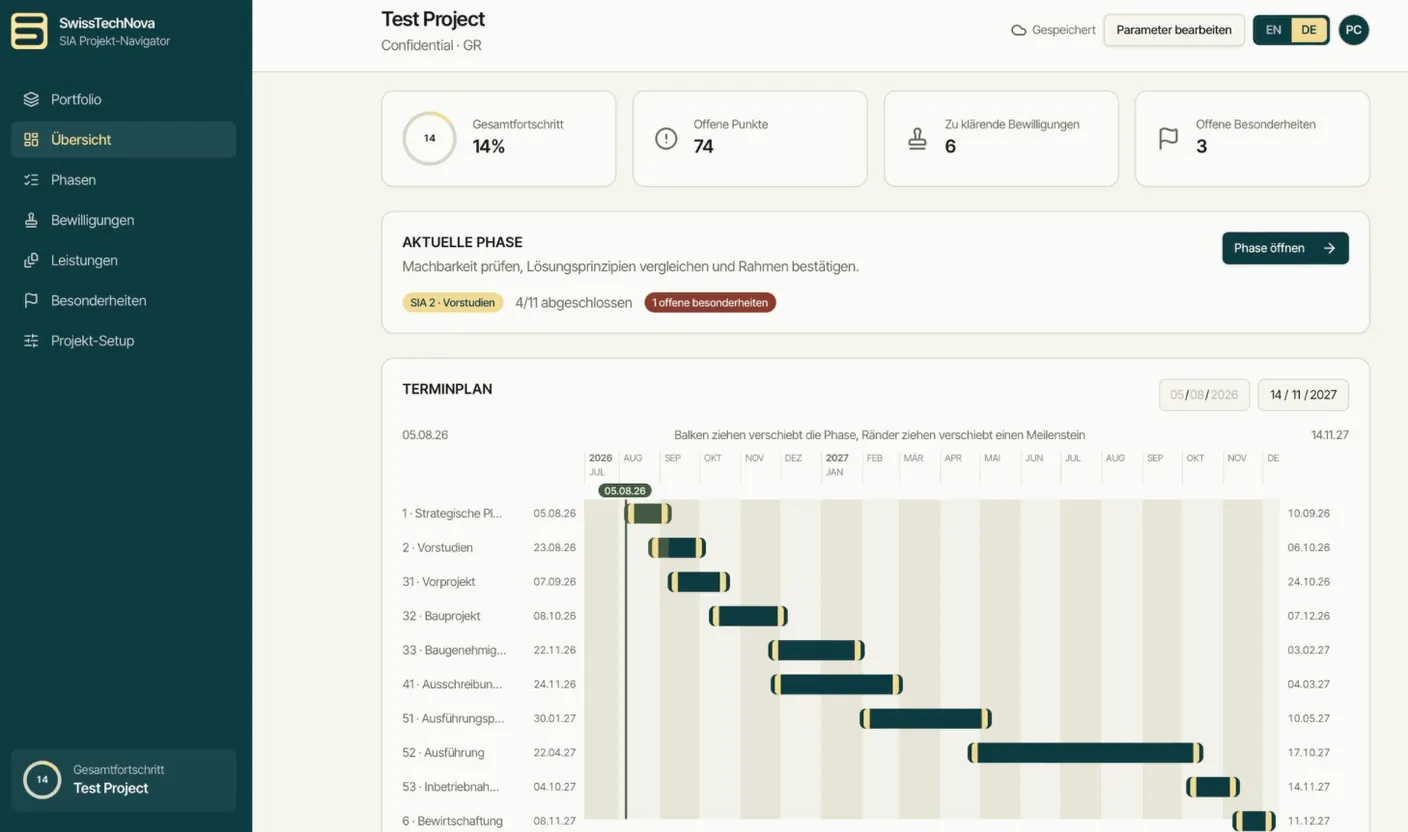
SwissTechNova's functional project portfolio management application, developed with no-code tools and LLM-supported development and structured around an SIA-oriented project framework.
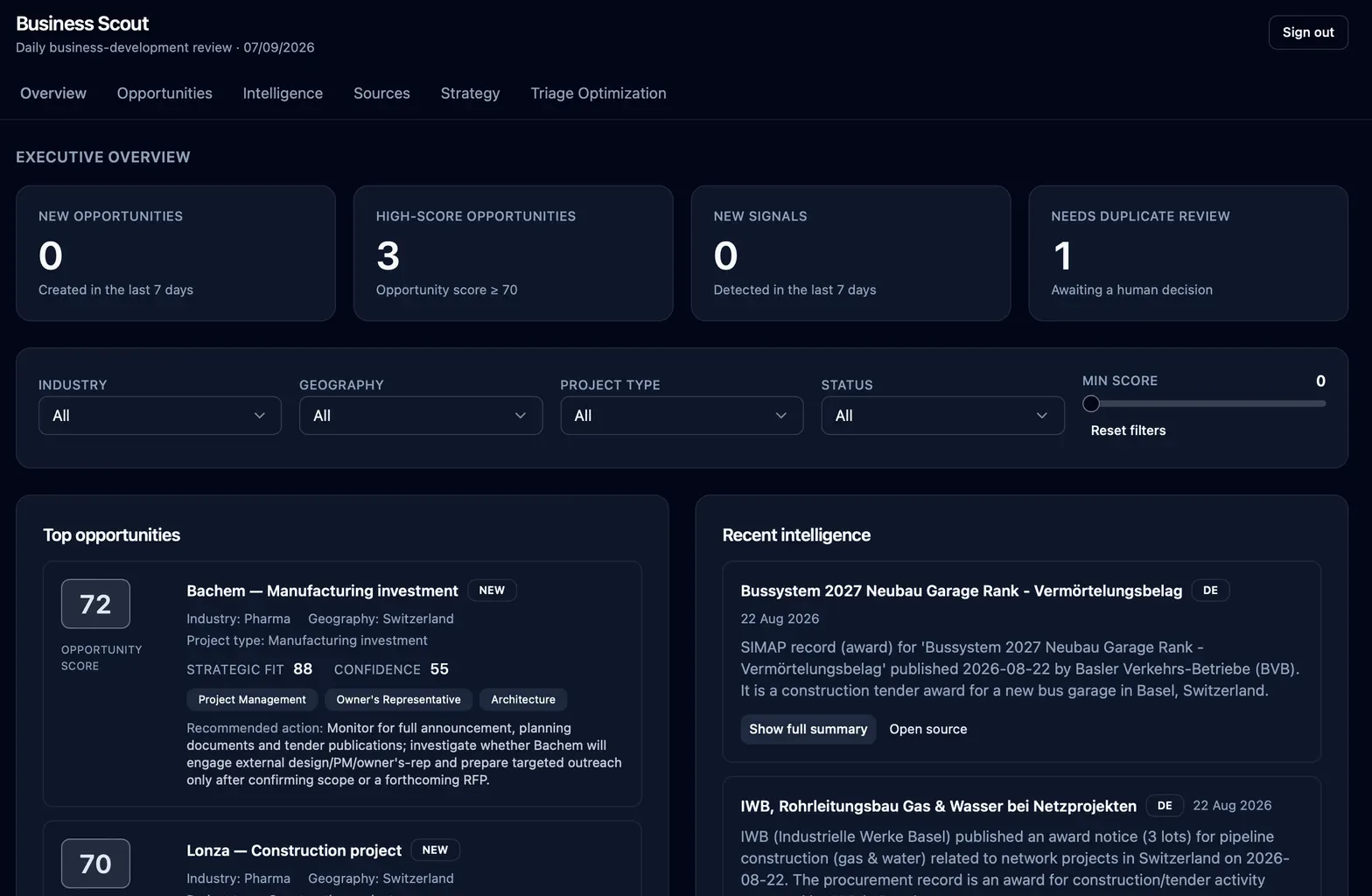
Business Scout, a functional demonstration exploring how no-code development and LLM guidance can make business intelligence more accessible.
What surprised us was not simply what these tools could do. It was how quickly somebody with domain expertise could move from an operational problem to a functioning application.
An LLM can help reason through a database structure, diagnose an automation error, formulate expressions, generate code, analyse edge cases, improve an interface or propose alternative implementations. No-code platforms then dramatically reduce the remaining development barrier.
That is extraordinary. It is also what prompted an uncomfortable question:
If computation is becoming this easy to create and consume, what physical resources sit behind it — and when is that consumption justified?
When the technical friction associated with producing more computation disappears, we may need to replace it with another form of discipline: purpose.
AI feels virtual. Its infrastructure is not.
A prompt appears almost weightless. We type a request. Seconds later, an answer appears.
Yet the process relies on physical infrastructure: processors, servers, data centres, electricity networks, cooling systems, water, buildings, semiconductor manufacturing and material supply chains.
The International Energy Agency projects global data-centre electricity consumption to more than double to about 945 TWh by 2030 in its base case. AI is the most important driver of that increase, although data centres would still represent just under 3% of total global electricity demand.
Recent research also cautions against reducing AI's footprint to electricity alone. A 2026 Nature Reviews Clean Technology review examines operational energy, carbon, freshwater and embodied infrastructure impacts, while highlighting trade-offs — for example, measures that reduce water use can under some circumstances increase carbon emissions.
So AI is not the global sustainability problem. But neither is digital activity immaterial.
Why our own AI footprint is so difficult to calculate
Suppose our applications trigger 10,000 LLM requests in a month.
How much electricity did they consume? How much carbon was associated with that electricity? Where was the computation performed? How much cooling water was required? What fraction of the manufacturing impact of the servers and accelerators belongs to those requests?
For commercial AI services, we often cannot answer those questions precisely. Users generally do not know all of the underlying hardware, utilisation, batching, data-centre location, electricity mix or cooling conditions.
Even the idea of the environmental impact of "one prompt" is problematic. A 2026 study in Joule estimated around 0.31 Wh for a conventional frontier-scale inference query under its baseline assumptions — but also found long reasoning queries could consume roughly thirteen times as much energy.
The number is less important than the lesson: a prompt is not a standard unit of computation. A request to classify a sentence, generate an image and operate an autonomous reasoning agent can have very different computational profiles.
For internal management, we therefore find a four-level distinction useful:
- Measured — directly observed.
- Provider-reported — disclosed by the service provider.
- Estimated — derived using transparent assumptions.
- Unknown — currently impossible to establish with reasonable confidence.
Environmental responsibility should not require false precision.
The deeper problem: efficiency does not necessarily reduce total consumption
This question connects to a much older issue in energy and economics.
Economic output has become considerably less energy-intensive over time. It would be incorrect to claim that GDP and energy demand remain mechanically linked.
The IEA's 2026 review illustrates real relative decoupling: global GDP grew about 3.1% in 2025 while energy demand increased 1.3% and energy-related CO₂ emissions roughly 0.4%.
That is genuine progress. But energy consumption still increased. Emissions still increased.
And over a longer period, UNEP reports that global natural-resource extraction has tripled during the past five decades. Without significant change, it could increase another 60% from 2020 levels by 2060.
This is why relative efficiency and absolute consumption need to be distinguished.
The same issue applies to AI. Suppose computation becomes twice as efficient. That is good engineering. But cheaper computation also makes additional applications economically viable. More applications create more demand. Greater demand increases infrastructure utilisation and can eventually justify building additional capacity.
The sequence can become: higher efficiency → lower cost → more applications → more demand → greater utilisation → additional capacity.
This is related to the rebound effect, and in its strongest form to the Jevons paradox. It would be wrong to claim that efficiency always increases total consumption. Rebound varies by sector, technology, price and behaviour.
The defensible conclusion is more useful:
Efficiency can reduce resources per unit without reducing total resource consumption if demand grows faster than efficiency improves.
That distinction should matter enormously to AI strategy.
Our own applications illustrate the issue
Imagine we halve the computational cost of an analysis in Business Scout. We have made it more efficient. But we may now decide to perform ten times more analyses. Or refresh them every hour. Or provide five interpretations instead of one. Or automatically run them across every business segment.
Likewise, once adding an AI feature to a project-management application becomes easy, we can add project summaries, risk detection, meeting preparation, document extraction, forecasting and eventually autonomous monitoring.
Every individual feature may be efficient. Total computational activity can still rise.
This does not mean those functions should not exist. It means each additional layer should earn its place.
Efficiency and sufficiency
Efficiency asks: how can we provide one unit of service with fewer resources?
Sufficiency asks: how much of that service do we actually need?
Technology policy usually concentrates on the first question. Sustainability requires both.
A company can become extraordinarily efficient at producing something nobody really needs.
That brings us to a second distortion: price.
Cheap computation may not reflect its full cost
Suppose an AI operation costs CHF 0.01. If it creates more than CHF 0.01 of business value, it appears economically rational to run it.
But the supplier's price does not necessarily include every environmental consequence. Economists call impacts that are not fully reflected in a transaction price externalities.
Carbon pricing tries to address part of this problem. But carbon taxes, ETS allowances, carbon credits and the social cost of carbon are not interchangeable.
The World Bank reports that direct carbon pricing now covers just over 29% of global greenhouse-gas emissions, with an average direct price of around USD 21/tCO₂e.
That market or regulatory price should not be mistaken for the complete long-term cost of climate damage — and still less for the cost of water scarcity, biodiversity impacts or material depletion.
A more defensible business tool is therefore a shadow environmental price. The World Bank itself uses shadow carbon pricing in economic analysis of relevant investment projects to incorporate climate consequences that normal financial analysis can otherwise miss.
For AI, a simplified calculation could be:
Estimated energy × electricity carbon intensity = estimated CO₂e
then:
Estimated CO₂e × internal shadow carbon price = shadow climate cost
The objective is not to discover the "true price of nature." It is to test whether a decision remains attractive when some environmental externalities stop being treated as free.
Run several assumptions. If an application remains valuable with a much higher carbon price, that is useful information. If its business case disappears as soon as environmental costs become visible, that is useful too.
Water, materials and biodiversity should generally remain separate indicators unless there is a robust methodology for monetising them. False comparability is not better accounting.
Make AI earn its resource cost
Our working principle has therefore become:
Use the least resource-intensive method that reliably produces the required outcome — and require additional computation to justify itself through additional value.
That does not mean always choosing the smallest model. A lightweight model that requires ten attempts and considerable human correction can be worse than a stronger model that succeeds once.
The better metric is resources per useful, reliable outcome.
That leads to a practical decision sequence.
Avoid → Substitute → Minimise → Measure → Price → Optimise → Justify
- Avoid. Does the task need AI? A formula, database query, deterministic automation, BIM function, checklist or professional judgement may be better.
- Substitute. If AI is useful, what is the least resource-intensive model or system that passes the required quality threshold?
- Minimise. Limit redundant generations, excessive output, unnecessary validation, retries and autonomous loops. Cache stable results.
- Measure. Track models, requests, tokens, automated calls, financial cost and estimated environmental indicators.
- Price. Apply shadow-cost scenarios where credible valuation exists.
- Optimise. Compare conventional, lightweight-AI, advanced-AI and hybrid human/AI workflows.
- Justify. Ask what measurable value the computation actually created.
For our project portfolio tool that might mean administrative time saved, risks identified earlier, fewer reporting inconsistencies or better resource allocation. For Business Scout it might mean information identified more quickly or decisions that are better supported.
This discipline also shapes how the tools are built. In Business Scout, for example, we deliberately embedded a deterministic algorithm that first shortlists only a few prioritised topics before any language model is involved. The LLM is then applied to that shortlist alone — which sharply reduces the mass of data the model has to process and reserves it for the step where it genuinely adds value.
Saving time is a legitimate productivity benefit. But it should not automatically be relabelled an environmental benefit.
Practical tools
Several resources can help organisations move beyond guesswork.
EcoLogits models environmental impacts from generative-AI inference, including usage and embodied components, and is particularly useful where direct measurement of remote APIs is impossible.
ML.ENERGY publishes measured model benchmarks including energy per token and per response, useful when comparing configurations rather than assuming that model size alone determines efficiency.
CodeCarbon tracks energy-related emissions for computation running on hardware you control and points users of remote GenAI APIs toward EcoLogits.
Green Algorithms provides an established calculator and methodology for computational carbon estimation.
Electricity Maps can add geographically and temporally differentiated electricity carbon intensity, including supported data-centre provider and region parameters.
World Bank Carbon Pricing provides context for carbon taxes, ETSs and crediting systems.
From efficient AI to conscious computation
There is probably no universal number of prompts or watt-hours at which AI suddenly becomes "sustainable." A more useful goal is conscious computation.
Before an AI workflow scales, ask:
- What problem does it solve?
- What is the realistic alternative?
- What happens if everybody uses it?
- What happens if one human action triggers twenty machine actions?
- What resources can we measure?
- What remains uncertain?
- What environmental costs are absent from today's price?
And most importantly: is the outcome valuable enough to justify those resources?
For us, this is not an argument against AI. The experience of developing our own tools has reinforced how powerful this technology can be. But innovation should remain a means, not an objective.
Sometimes the appropriate choice will be a powerful model. Sometimes a smaller one. Sometimes conventional software. And sometimes the most technologically mature decision will be: do not compute this.
That, for us, is what it means to put innovation at the service of society.
AI sustainability checklist
Before approving or scaling an AI workflow:
- ☐ We can clearly state the problem it solves.
- ☐ We have identified the realistic non-AI alternative.
- ☐ We tested whether a smaller or simpler system meets the quality requirement.
- ☐ We know approximately how many model calls the workflow generates.
- ☐ Automated retries and agent loops have explicit limits.
- ☐ We track absolute usage as well as efficiency per task.
- ☐ Environmental numbers are labelled measured, reported, estimated or unknown.
- ☐ Where possible, we use location-specific electricity carbon intensity.
- ☐ We have considered carbon, water and hardware impacts separately where material.
- ☐ We have tested the decision using a shadow environmental cost where appropriate.
- ☐ We have evaluated what happens if usage increases 10× or 100×.
- ☐ A human remains accountable for consequential decisions.
- ☐ We can identify a measurable benefit from the computation.
- ☐ We periodically reconsider whether AI remains the best solution.
Final test:
If this computation were less artificially cheap — or if everyone performed it at scale — would we still consider it worthwhile?
Want to test the project portfolio tool?
The applications that triggered this reflection are functional — not conceptual mock-ups. Business Scout remains a demonstration environment. For the project portfolio management tool, we would like to go one step further and invite real users into the experiment.
We are opening test access to a first group of users, and we are particularly interested in what testers consider genuinely useful, what should remain deterministic, and where AI creates enough additional value to justify its inclusion. That discussion is part of the experiment.